
L etters
Wine Release. 3. Winter 2025.
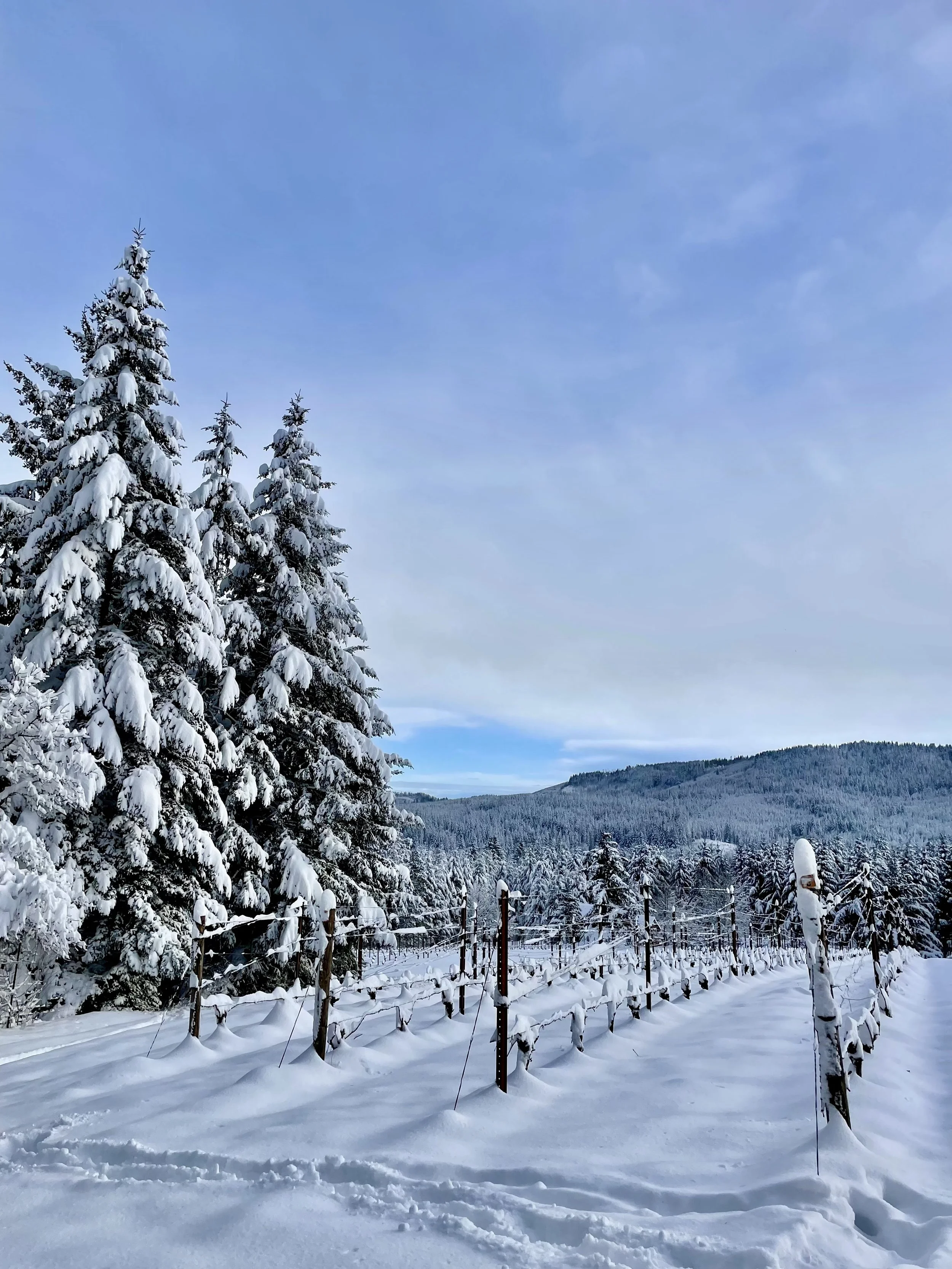
On Rain. And Sun.
The seasons of the Willamette Valley exist today in sharp contradiction. During the peak of summer, as the drought-ridden ground turns yellows and browns, the vines stand in stark contrast against this neutral canvas, their emerald canopies reaching up towards uniformly clear, blue skies. Without any measurable summer rainfall in most years, our dry-farmed vines (i.e., farmed without irrigation) are instead powered by extensive root systems that reach deep into the ground in search of water. Above ground, sixteen hours of abundant daylight at the equinox provides for ample photosynthetic opportunities to help feed the plants. At its core, grapevines rely on such a simple equation – food and water – that is not dissimilar from our own existence.
Past the equinox, daylight slowly begins to wane as we move towards fall. The grapes began to swell and ripen, adding small pops of reds and purples to the summer color palette across the Valley, and signaling that harvest is near. Once the grapes are picked, a beautiful and sudden shift occurs, just as the rains return. The transition back into the rainy season is often abrupt. But for our organically farmed vineyard – the soil rich in organic matter from cover crops, wildlife, and minimal tillage – there’s an embrace of this long overdue moisture, the ground bursting back into a blanket of green seemingly overnight. Conversely, the vines turn inward, no longer searching for water and sunlight but rather preparing to recharge themselves for the next growing season, having completed their goals for the year. But before the vines completely shut down and drop all of their leaves, they provide us one last gift as their canopies ignite into glorious shades of gold, once again standing in contrast to the now green ground all around them, the two having exchanged colors until the following spring.
There’s immense beauty in both the dry and rainy seasons. The dry summer months are accentuated by long, often cloudless days, which bathe in sunlight the fields and gardens growing world-class fruits and vegetables that dominate the landscape of the Willamette Valley. Days are spent outside, our appreciation for dry, sunny weather only heightened by the lack of it throughout the rest of the year. This lack of summer rain helps us avoid the threat of powdery mildew – one of the biggest threats to healthy grapes in the Valley – aided by the constant marine winds that blow across the farm every evening from the west. But as we reach late summer, the threat of wildfires can begin to overshadow the joy we felt earlier in the year when the rains stopped and the sun reemerged. It’s during late summer that both farm and winery work begin to crescendo and overlap, made more difficult by relentless heat, and we find ourselves yearning for the return of the rain and clouds.
And then it comes. Smoke from outdoor grills and the occasional wildfire is replaced by plumes of smoke from fireplaces that dot the landscape, as life shifts more indoors in much the same way the vines move inward during this time of year. Brilliantly sunny mornings are replaced by an unmistakably beautiful moodiness, clouds blanketing the valleys and hills, and a persistent drizzle that seems to come more than it goes. As farmers, we know that rain is critical to what we do, especially as summers seemingly become longer and warmer. We need the rains to replenish the ground water, ensuring the vines have ample supply to tap into during the following growing season. The return of the rain also signals that the opportunity to recharge is, for the first time in a while, on the horizon. There’s often still ample work to do in the winery, with daily tasks to manage until the wines are barreled down and put to bed for the year. But for the first time in a while, there’s proverbial light at the end of the tunnel. A light – often now coming from the hearth, rather than the sky, to combat the darker, shorter days – that asks us to slow down, reflect, and reconnect.
The 2023 Vintage.
If you’re interested in an in depth look at the 2022 vintage - which is vintage that the “Douglas Fir” Pinot Noir released today was crafted from - please revisit our Winter 2024 release letter from last year here. For more detail on the 2023 growing season, continue reading on below.
After a 2022 season marked by extremely volatile weather – snowfall, frosts, heat domes – the 2023 growing season was a return to relatively calmer weather. Overall, while annual average highs during the 2023 growing season were ~2 degrees higher than in 2022, growing degree days (GDDs) were drastically lower between budbreak and harvest – more than 200 units lower – in part due to a harvest that came almost three weeks earlier than in 2022. GDDs, while imperfect, are a good measure of the amount of heat exposure above a “base temperature” (50 degrees F for grapevines) that plants need to grow; temperatures below the base temperature (or too high above it) are generally when plant growth pauses until the temperature moderate once again. The resulting impact to the grapes of lower GDDs throughout the growing season manifests in more finesse and freshness in the wines when compared to the 2022’s.
Despite not having the late-spring frosts and snowfall as we experienced in 2022, budbreak still did not occur until May 8th – unusually late and just a few days earlier than the May 13th budbreak the year prior. This was likely due to the combination of factors, including the vines depleted energy stores from the longer season and later harvest in 2022 (meaning the plants had to use up more energy during the growing season, and then having less time to recover before kicking back into gear again the next spring), less early season rainfall, and cooler overall temperatures during the first few months of the year.
From that point on, while average temperatures trended warm during the heart of the growing season, we experienced less of the dramatic heat spikes or “domes” than we did in 2022, which allowed for gentler, more consistent grapevine growth. This was particularly the case in the last few weeks leading up to harvest, as temperatures were ideal, which allowed the grapes to ripen slowly during this critical phase of their life cycle, helping to aid phenolic development while keeping better balance between the sugars and acids in the berries.
Overall, the fruit arrived at the winery across several days from September 20th to the 24th, all in near perfect condition, providing that characteristic Cancilla intensity and structure, with just a little bit more “prettiness” than in 2022. And as we continue to learn about this site each and every year, we get just a little bit closer to perfecting how to care for this place, in order to grow the highest quality grapes and translate that into the highest expression of wines made from Cancilla Vineyard. Vintage 2023 was no different, as we felt we made monumental steps towards getting closer to those goals, however elusive that may be.
Additional details on each of the three wines is included below.
The 2022 Cancilla Vineyard Pinot Noir “Douglas Fir
The last release from the 2022 Vintage is the “Douglas Fir” Cancilla Vineyard Pinot Noir. A sibling wine to “Lichen” released last winter, and born from the same blind blending process, the blend that became Douglas Fir stood out uniquely at the table, offering darker fruits and a more robust structure than Lichen.
The grapes that go into Douglas Fir were picked across two days – October 14th and 19th – with the lack of rainfall and warmth of the 2022 growing season resulting in intensely small and concentrated clusters. Following fermentation in open-top macrobins, the newly fermented wines were pressed off on November 1st of that year, before spending 15 months in neutral French oak barrels. Those barrels were then tasted and blended blind to determine the final blend for “Douglas Fir”. Given the added structure and density, we felt that Douglas Fir needed more time in bottle than the rest of the 2022’s, and thus held it back for release until today, where it is just starting to beautifully round into form.
Like all of our 2022 Cancilla Vineyard wines, the 2022 Cancilla Vineyard “Douglas Fir” is marked by density and structure, largely influenced by the vineyard’s marine sedimentary soil and a hot, dry summer in 2022. Douglas Fir opens to a bouquet of red and black fruits and a freshness that belies its three years of barrel and bottle aging. The forest floor character that influences the wine’s name is subtly present at first, becoming more intense as the wine has time to open in the glass. The palate matches, with intense black cherries and wild blackberries coming through, along with forest floor and winter spices. Its tannin profile, just beginning to soften with an extra year in bottle, still makes itself known throughout, balanced by a vibrant acidity and an extended finish. The wine reminds us of hiking through dense Oregon forests, surrounded by towering firs and oaks, dark and damp even during the peak of summer.
The 2023 Cortell Rose Vineyard Gamay Noir
The second wine in this release is the 2023 Gamay from Cortell Rose Vineyard, located in the Eola-Amity Hills AVA within the Willamette Valley. The second iteration of this wine for Throughline, the fruit that goes into this wine is the only fruit to date that we’ve worked with outside of our own estate vineyard. The fruit was picked on September 24th and arrived at the winery in near perfect condition. Much like the 2022 version, half of the fruit was sealed in a tank with the oxygen removed to undergo carbonic maceration, while the other half of the fruit was destemmed and put into open top fermenters. The carbonically macerated grapes were unsealed after being untouched for 20 days, before being pressed to off the skins to finish primary fermentation. Coincidentally, we pressed the destemmed fruit that same day, having finished primary fermentation the day prior. Both the carbonically macerated and destemmed grapes were put into neutral French oak barrels to age, spending more than 20 months in barrel before being blind blended and bottled this past June. The final blend was comprised of 50% of the carbonically macerated wine with the other 50% made up of wine from the barrels of destemmed fruit.
Despite similar winemaking techniques, the 2023 Cortell Rose Vineyard Gamay is decidedly distinct from the 2022 version of this wine, highlighting the vintage variation between the 2022 and 2023 growing seasons. In the glass, the wine is noticeably more translucent than the 2022. The nose reminds us of summer strawberries and raspberries mixed with wild herbs, with a slightly savory, mushroom character from the extended time in barrel. There’s a surprising intensity on the palate in terms of both flavor and texture, leading to a long, elegant finish. The 2023 Gamay is marked by its versatility, drinking beautifully at a variety of temperatures and contexts, from a refreshing chill by itself on a warm day or playing beautifully with almost any food on your tables.
The 2023 Cancilla Vineyard Chardonnay
The 2023 Cancilla Vineyard Chardonnay stands out amongst the wines we’ve made to date. In many ways, this wine best embodies the goals and philosophies of Throughline Wines to craft beautiful, unique, and honest expressions of true Oregon terroir. When we were gifted a neutral barrel made from beautiful, Oregon white oak by Evan Martin, we were overwhelmed with anticipation of taking another step in service of that philosophy. Rather than aging the wine in oak from 5,000 miles away in France – as is the overwhelming standard for wines across the globe, including most of our own wines – we fermented and aged our 2023 Cancilla Vineyard Chardonnay in Oregon oak, bringing us closer to creating an end-to-end product that is quintessentially Oregon.
The chardonnay grapes that make up this wine were picked on September 20th, a beautifully clear, chilly Oregon fall morning. Once at the winery, the grapes were foot tread and left to macerate on the skins for 24 hours to pull out additional flavor and phenolics from the grape skins, to help bring more balance to the tropical fruit character that is characteristic of the chardonnay from our vineyard. After 24 hours, the chardonnay grapes were pressed and put into that singular Oregon oak barrel to ferment. From there, the newly pressed grape juice underwent a long, slow fermentation, as is preference for our chardonnays. This slow, cool approach to fermentation helps to preserve some of the more delicate aromas of the wine. Without temperature control outside of utilizing the sun and shade, the wine is left to ferment closer to the rhythm of nature, with fermentation progressing faster during the last few warm, sunny days in early fall and slowing as the days shorten and the temperatures drop not winter. The wine finally finished primary fermentation and malolactic conversion in the spring of 2024.
From there, the wine remained on its lees throughout its 20+ months in barrel, with occasional stirring of those lees to resuspend them in the wine to help further develop texture and autolytic character. Throughout aging, we also left the wine for extended periods of time without topping, a process whereby the headspace in the barrel due to evaporation is “topped up” or eliminated by filling it with wine. Differing from French oak barrels, Oregon white oak is much tighter grained, resulting in less oxygen exchange and evaporation, while also bringing in a gentle, reductive quality to the nose of the wine.
The resulting wine is one of truly unique complexities. The nose starts with a hint of matchstick reduction, before opening into delicate tropical fruit notes characteristic of Cancilla Vineyard, mixed with citrus pith, almond, and white flowers. On the palate, the wine begins to lean further into the savory – think preserved lemon and salted almonds – with subtle notes of pineapple, guava, and quince. The finish is long, with distinct phenolic character that provides harmony to the various flavors on the palate.
Given that we currently only have a single Oregon oak barrel, only one barrel of the 2023 Cancilla Vineyard Chardonnay was made, making quantities extremely limited. And given the extended barrel aging that extended past the 2024 vintage, we won’t have another Chardonnay that was aged in Oregon oak until 2025. In order to share the wine with as many as possible, quantities are limited to 3 bottles per customer.
Come See Us.
As a reminder, we offer several options for you to enjoy Throughline Wines either in-person or virtually. Given the small quantities of wine we produce, reservations are limited and by appointment only. All tastings will include a selection of Throughline Wines alongside a few inspirational wines from winemakers across the world, in addition to locally produced bites (think peak season fruits and vegetables, fresh breads and pastries, local cheeses). Please use the “Visit Us” button below to visit the website for more information and, as always, please don’t hesitate to reach out directly with any questions. We look forward to welcoming you, whether near or far, to experience these wines and this place with us.
Final Thoughts.
We often wonder when the moment will occur that it begins to feel normal that we get to share with the world these wines that we’ve poured so much of ourselves into. In many ways, we hope that moment never comes. That imposter syndrome helps keep us unrelentingly curious and in search of improvement every day, every vintage. We are constantly reading and asking questions and spending time in the vines, always searching for ways to better care for the vines and the best ways to translate that through the wines themselves. This includes constantly seeking out new wines to try from every corner of the world, trying to learn the techniques behind the “why” of those bottles and how those lessons may be adapted to our own processes in the vineyard and winery. All in the hopes of creating something beautiful for you to enjoy.
From the bottom of our hearts, thank you. Wishing you all a happy holidays.
A.J. and Katie
The rain is back. An understood inevitability in the Willamette Valley, yet something so often misunderstood by those who live elsewhere. It is the first thing that comes to mind for most people throughout the country when they think of Oregon, yet the reality of the rain – and our intimate relationship to it – often defies outsider expectations. For us, the rain is a welcome part of a beautiful and critical annual cycle. It marks a return to slowness, to rebirth, for both the vines and those who tend to them.
It is during this time when the rains return that our focus shifts from the all-encompassing intensity of harvest back to having time to prepare for wine releases and holiday events. Less of the time sensitive tending to vines and wines and more towards regaining the bandwidth to tell of their incredible stories that we’ve experienced along the way. It is in this space, sitting by a crackling fire, that we graciously write to you again today.
We are releasing three new wines: the last of our 2022s – the “Douglas Fir” Cancilla Vineyard Pinot Noir – and our first two wines from the 2023 vintage – the Cortell Rose Vineyard Gamay and the Cancilla Vineyard Chardonnay. These wines are available for purchase here. In addition, we are also offering a couple different “packs” that offer a selection of wines for a special discounted price. The packs are a two vintage mini-vertical of our 2022 and 2023 Gamays, and a “Pinot Party Pack” offering all three of our 2022 pinots.
As a reminder, returning customers should use code TLWINE2025 to receive 10% off your next order (note that the 10% discount does not apply to the already discounted packs). For those interested in additional details about the release and each of three wines, please continue reading below. Note that wines ordered prior to November 12th (next Wednesday) will ship no later than Friday, November 14th, and thus should arrive in time for your Thanksgiving holiday, barring any unexpected delays. After that, wines will generally ship once a week. Please do not hesitate to reach out directly with any questions.